Hard drive and data destruction in Tijuana
Hard drive destruction and secure erasure of every storage medium: aligned to the NIST 800-88 standard, with a per-serial-number certificate, a documented chain of custody and Mexican LFPDPPP compliance. Your company’s information is never exposed.
- NIST 800-88 secure erasure
- Certificate per serial number
- Chain of custody documented
- NOM-161 recycling of destroyed media
What certified data destruction is (and what it is not)
Certified data destruction is the irreversible elimination of the information stored on your company’s media — hard drives, SSDs, servers, backup tapes, phones — backed by documentary evidence of every step: which device was processed, with what method, when, and by whom. The deliverable is not just a clean drive; it is a file you can put on the table when an auditor, a client or headquarters asks what happened to the information on those machines.
What it is not: formatting the drive, deleting files, or a factory reset. A quick format only removes the file index — the information is still there and can be recovered with publicly available tools. Every device your company donates, resells or scraps without proper sanitization is a potential data breach.
Compliance on both sides of the border: NIST 800-88 and Mexico’s LFPDPPP
For a U.S. company operating in Mexico, NIST 800-88 covers the technical side your headquarters expects — but it is not the law that applies to your Mexican entity. Companies that handle personal data in Mexico are bound by the Federal Law on Protection of Personal Data Held by Private Parties (LFPDPPP), which requires that information be eliminated so it cannot be recovered, and that you can prove it. Penalties can reach hundreds of thousands of UMAs (up to 320,000 — double for sensitive data such as health or financial records).
Most vendors targeting cross-border clients anchor only on the U.S. standard and skip the Mexican legal framework that actually binds your local operation. Our certificate and chain of custody are built to serve as evidence for both: your U.S. audit and your Mexican compliance file.
NIST 800-88: Clear, Purge, Destroy
The global reference for media sanitization is NIST Special Publication 800-88, the standard most corporate security policies cite — including the headquarters of nearshoring companies on the border. It defines three levels: Clear (logical overwrite, protecting against software-based recovery), Purge (deeper techniques such as cryptographic erase, making recovery infeasible even with lab methods — the usual level when equipment leaves the company for reuse or resale) and Destroy (physical destruction that renders the media unusable). At Tianlu we apply secure erasure aligned to NIST 800-88, or physical destruction, depending on each device and risk level.
Erase or destroy? How to decide
If the equipment will be reused or resold, secure erasure keeps the drive functional and preserves the asset’s value — pair it with our asset valuation & buyback service. If the media is damaged, obsolete or your policy demands physical elimination (common in banking, healthcare and government), destruction leaves it unusable and the materials are recycled. In real projects both paths coexist, and the certificate documents the method applied to each serial number.
How a hard drive is physically destroyed (and why SSDs are different)
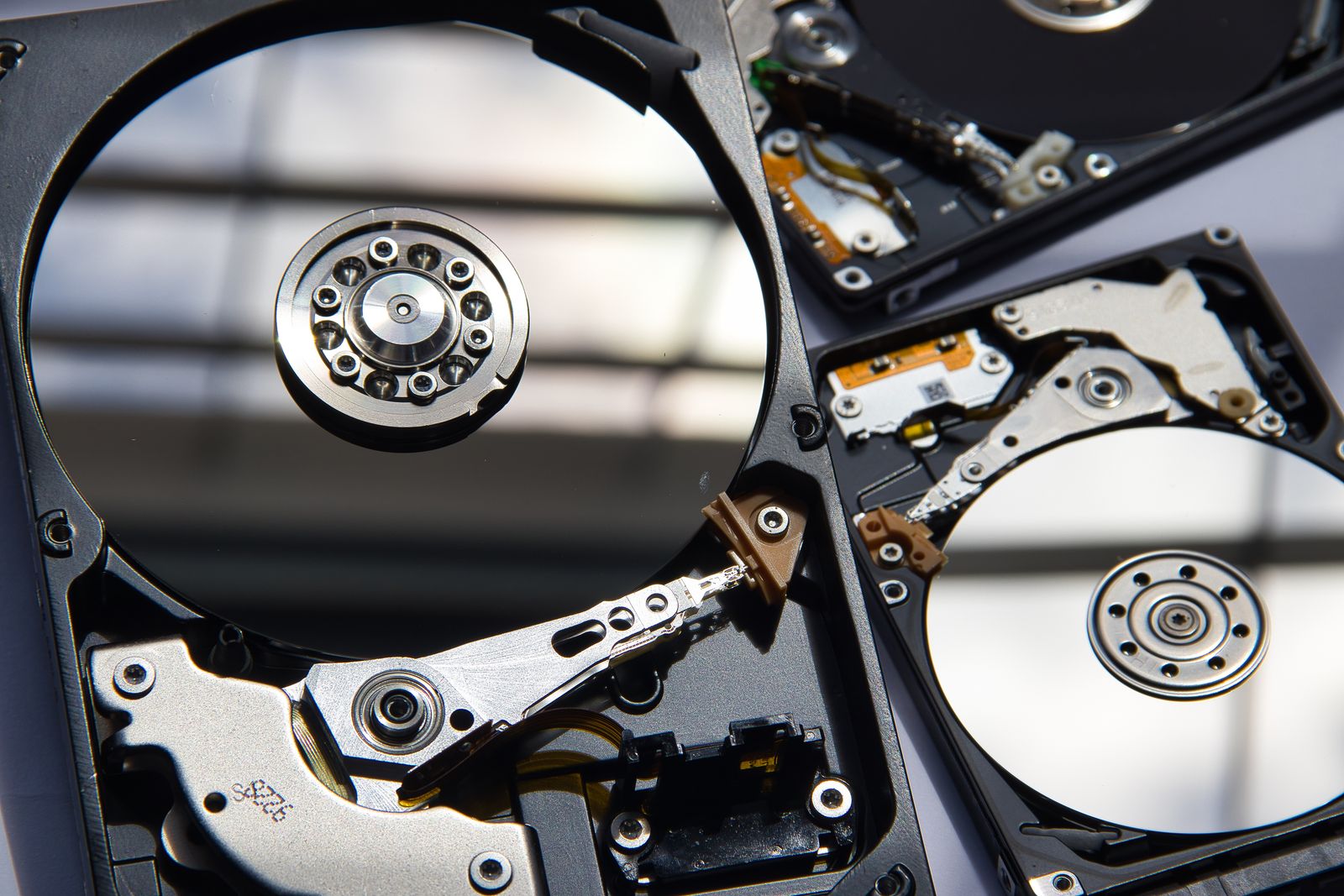
When the decision is to destroy the hard drive rather than erase it, the right technique depends on the media type. A mechanical drive (HDD) stores data on magnetic platters; a solid-state drive (SSD) stores it on flash memory chips — and they don’t die the same way:
- Shredding. The media is broken into particles. The most definitive method, valid for both HDDs and SSDs — provided the particle size is fine enough for an SSD’s memory chips.
- Punching / deformation. The platter is pierced or bent to disable it. Fast for damaged or worthless HDDs, but can leave readable fragments unless combined with shredding; unreliable on its own for SSDs.
- Degaussing. A strong magnetic field wipes an HDD and leaves it unusable. Highly effective on mechanical drives, but it does not work on SSDs or flash memory, which don’t store data magnetically.
This matters: destroying an SSD as if it were an HDD — for example, only degaussing it — leaves the data intact. So before destroying, we identify the media type, apply the technique that truly renders it unusable, and document it by serial number on the certificate.
The process, step by step
- 1
Assessment and scope
You tell us which media need sanitizing (drives, SSDs, servers, tapes, phones), the volume and your audit requirements. We define the right method together — secure erasure or physical destruction — and quote with no obligation.
- 2
Pickup with chain of custody
We collect the equipment at your facility and every device is logged by serial number from the moment it leaves your company. The chain of custody documents who held the material at every step.
- 3
Sanitization or destruction
We apply secure erasure aligned to the NIST 800-88 standard, or physical destruction that renders the media unusable, depending on device type and the risk level of your information.
- 4
Verification
Each device is verified after processing: the erasure must be effective or the physical destruction complete. No device moves on to reuse or recycling without this check.
- 5
Certificate and evidence
You receive a destruction certificate per device — serial number, method, date and operator — together with the chain of custody: the evidence that backs your compliance in audits.
The certificate: your compliance evidence
For a destruction certificate to hold up in an audit it must identify each device unequivocally. Ours includes, per device: the serial number, the method applied (NIST 800-88-aligned erasure or physical destruction), the date and the operator. Together with the chain of custody, it forms the evidence file for internal, client, headquarters or regulatory audits.
Don’t forget the “invisible” media: office printers with internal drives, network gear holding credentials, corporate phones, USB sticks and backup tapes. They are the devices that most often slip through sanitization policies — we cover them too.
Cross-border advantage: destroy data locally
U.S. companies with nearshoring operations in Tijuana, Mexicali, Ensenada, Rosarito or Tecate do not need to ship equipment back across the border to sanitize it. We do it on this side — bilingual process, certificates valid as evidence in both countries — so data-bearing drives travel as little as possible. See our cross-border ITAD page.
After the data: recycling and value recovery
Data destruction is one link in the full disposition chain. Once the information is gone, functional equipment can be refurbished or resold, and end-of-life media is recycled under Mexico’s NOM-161 regulation with its own documentation. For the complete cycle, see our IT asset disposition (ITAD) service and our electronics recycling guide, plus NOM-161 compliance.
Certified data destruction: FAQ
What is certified data destruction?
It is the irreversible elimination of the information stored on hard drives, SSDs and other media, backed by documentary evidence: a per-serial-number certificate stating the method applied, the date and the operator. Unlike a simple format, certified destruction guarantees the data cannot be recovered — and gives you the proof for any audit.
Why is formatting a drive not enough?
A quick format only deletes the file index, not the information itself. With publicly available recovery tools, much of that data can be read again. Secure erasure per standards like NIST 800-88 overwrites or purges the information so it cannot be recovered, and physical destruction renders the media unusable.
What is the NIST 800-88 standard?
It is the media sanitization guideline from the U.S. National Institute of Standards and Technology (NIST Special Publication 800-88), the most widely used reference in the industry. It defines three levels — Clear, Purge and Destroy — and helps decide which one to apply based on data sensitivity and the device’s next destination.
When should we erase and when should we physically destroy?
If the equipment will be reused or resold, secure erasure preserves its value: the drive comes out clean and functional. If the media is damaged, obsolete, or your internal policy requires physical elimination, destruction renders it unusable. A certificate is issued either way; we help you decide case by case.
Can U.S. companies with operations in Mexico use this service?
Yes — it is one of our specialties. Nearshoring operations in Tijuana and Baja California can destroy data locally, with bilingual service and per-serial-number certificates that work as audit evidence on both sides of the border, without shipping data-bearing equipment back to the U.S.
What happens to the drive or device afterwards?
Functional equipment can be reused or resold after erasure, recovering part of its value. Physically destroyed media and end-of-life devices are recycled under Mexico’s NOM-161 regulation, with their own documentation. Nothing ends up in regular trash.
Is secure erasure enough to comply with Mexico’s LFPDPPP?
It can be. The LFPDPPP does not mandate a specific method — it requires that the information be eliminated so it cannot be used or recovered, and that you can prove it. Secure erasure aligned to NIST 800-88, verified and backed by a per-serial-number certificate, meets that goal when the equipment will be reused. If the media is damaged, cannot be verifiably erased, or your policy requires it, physical destruction applies. Either way, what sustains compliance is the documentary evidence, not the method itself.
When is physical destruction of a hard drive mandatory?
There is no single rule — it depends on the state of the media and your security policy. Physical destruction is the route when the drive is damaged and cannot be verifiably erased, when it is obsolete with no reuse value, or when your organization’s internal policy — common in banking, healthcare and government — requires physical elimination. If the equipment keeps its value and can be verifiably erased, secure erasure is usually enough and lets you recover that value.
What is degaussing, and does it work on SSDs?
Degaussing applies a strong magnetic field that wipes a mechanical hard drive (HDD) and leaves it unusable. It is highly effective on HDDs, but it does not work on solid-state drives (SSDs) or flash memory, because they do not store data magnetically. For SSDs we use device-level secure erase commands or fine-particle shredding. That is why we identify the media type before choosing the method.
How much does certified hard drive destruction cost?
It depends on the volume of media, the method (erasure or physical destruction), the logistics and the level of evidence you need. We don’t quote a blind per-unit price: tell us how many drives or devices you have and what certificate you require, and we return a clear, no-obligation quote. In every case, the cost is a fraction of what a data breach implies.